Best RAM for AI Servers in 2026 Which Type to Buy?

Time:2026-09-25 Author:Charlotte
0%

Choosing the Best RAM for AI servers in 2026 starts with a distinction many buyers overlook: system memory is not GPU memory. DDR5 ECC RDIMMs support host workloads, while HBM sits close to accelerators and supplies much higher bandwidth. They solve different problems. A large language model can still pause when CPU memory, data pipelines, or storage cannot keep pace.

The Stanford Institute for Human-Centered AI’s 2025 AI Index reports that training compute for notable models has doubled about every five months. Training datasets have doubled about every eight months. Those trends make capacity, bandwidth, and memory-channel configuration practical purchasing questions—not just specification-sheet details. NVIDIA CEO Jensen Huang summarized the broader shift at GTC 2024: “The future of computing is accelerated computing.” For server builders, that acceleration depends on balanced memory and compute.

In this guide, we compare DDR5 ECC RDIMMs, newer high-bandwidth server memory options, and CXL memory expansion. We explain where each fits, what to check in a server’s platform documentation, and why maximum capacity is not always the best choice. A database-heavy inference node may benefit from more system RAM; a GPU-dense training server may be limited elsewhere. It depends.

One caution: vendor roadmaps change quickly, and availability varies by platform. A faster module is not automatically a faster server. The right choice comes from workload testing, validated configurations, and a realistic budget—not one headline bandwidth number.
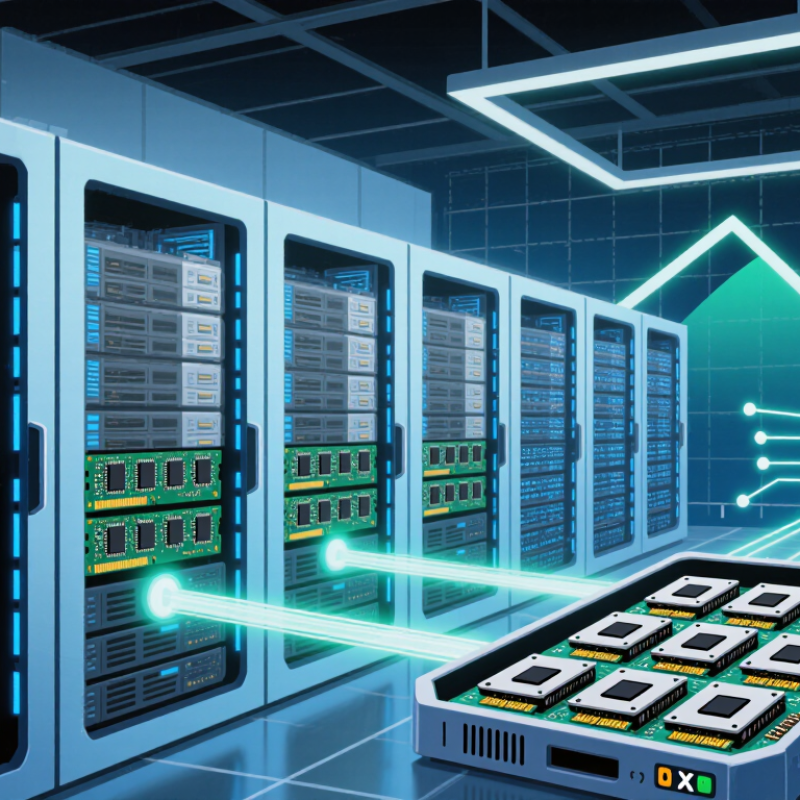
Best RAM for AI Servers in 2026 Which Type to Buy?

How AI Server Workloads Use System Memory

In an AI server, system RAM is the workbench around accelerator memory. It holds data before transfer, supports CPU-side preprocessing, and can cache checkpoints or retrieval indexes. A request may pass through several buffers before reaching an accelerator. That movement takes memory capacity and bandwidth. If host RAM runs short, data loading can stall; extra RAM, however, does not automatically make model responses faster.

Stanford HAI’s 2025 AI Index reports that the cost of querying a GPT-3.5-level model fell from $20 to $0.07 per million tokens between November 2022 and October 2024. That price shift helps explain why serving workloads may grow, though it does not prescribe a RAM size. For many servers, ECC DDR5 registered memory is a practical baseline. Check channel population, NUMA placement, and peak dataset or batch size—not just total gigabytes. A simple sizing rule can mislead. I would benchmark with real preprocessing and retrieval enabled; otherwise, memory needs can look deceptively low. IDC’s 2024 Worldwide AI and Generative AI Spending Guide projected global AI spending would reach $632 billion in 2028, but each workload still needs its own memory test.

Which RAM Types Are Available for AI Servers in 2026?

AI servers can use several memory types, and the right choice depends on workload, processor support, and capacity needs. DDR5 ECC registered DIMMs are a common foundation. They add error correction and suit systems running large models, data pipelines, and virtual machines. Check the server’s supported speed and capacity before buying; a faster module may run at a lower speed when many slots are populated.

LRDIMMs use buffering to support higher capacities per module, which can help when a server needs large memory pools. MRDIMMs can provide greater bandwidth on compatible platforms, but they are not interchangeable with standard registered DIMMs. Platform support matters. For workloads that repeatedly move large datasets, memory bandwidth can affect performance as much as total capacity. For lighter inference tasks, buying the highest-capacity modules may add cost without a clear benefit.

High-bandwidth memory, or HBM, is another important type in AI systems. It sits close to processors or accelerators and feeds them data quickly, but it is not a standard server DIMM. Some systems also use CXL-attached memory to expand capacity; added latency can make it less suitable for every workload. Small details matter. I would compare measured workload performance, power use, and upgrade limits rather than assume one memory type is best. Specifications do not always predict real results.

Best RAM for AI Servers in 2026: Which Type to Buy? — Which RAM Types Are Available for AI Servers in 2026?

Memory type Form factor and role Typical performance or capacity characteristics Advantages Limitations Best fit for AI servers
DDR5 RDIMM Registered DIMM; standard main memory for many current server platforms. Common supported data rates vary by platform and generation; DDR5 server configurations commonly operate in the 4,800–6,400 MT/s range. Capacity depends on module density and system support. Broad server-platform support, error correction, scalable capacity, and a mature supply ecosystem. Lower bandwidth per socket than high-bandwidth accelerator memory; populated memory channels and supported DIMM speeds affect performance. The default choice for host memory, data loading, preprocessing, CPU-side workloads, and general-purpose AI infrastructure.
DDR5 3DS RDIMM A registered DDR5 DIMM using stacked DRAM dies to increase capacity per module. Typically offers higher capacity per DIMM than conventional modules; data rate and maximum capacity depend on the memory controller and server platform. Enables large memory configurations with fewer DIMM slots occupied. Higher cost per module; platform validation and supported capacity must be checked before purchase. Large in-memory datasets, memory-heavy analytics, and systems where capacity per socket matters more than lowest cost.
DDR5 MRDIMM Multiplexed-rank registered DIMM designed to increase effective memory data rate on compatible platforms. Some supported implementations target data rates up to about 8,800 MT/s; actual operation depends on the processor, motherboard, and DIMM configuration. Can provide higher memory bandwidth than standard RDIMMs without changing to a different DIMM form factor. Platform availability is more limited, and higher data rates may require specific configurations and validation. Bandwidth-sensitive CPU workloads and AI data pipelines when the server platform explicitly supports MRDIMMs.
CXL Type 3 memory Memory accessed through a Compute Express Link (CXL) device; commonly used as an expansion or memory-pooling tier rather than a DIMM replacement. Capacity and bandwidth vary by device and CXL generation. Access latency is generally higher than local CPU-attached DRAM. Can expand memory capacity and support flexible memory allocation across compatible systems. Requires compatible processors, firmware, operating systems, and CXL devices; it is not a drop-in DIMM and is not ideal for every latency-sensitive workload. Capacity expansion, memory pooling, and larger working sets that do not fit economically in local DRAM.
HBM High Bandwidth Memory integrated or closely packaged with an accelerator; it is not a standard server DIMM. Provides very high bandwidth and substantial on-package capacity; available generations and specifications vary by accelerator. Feeds data rapidly to AI accelerators and is important for many large-model training and inference workloads. Usually fixed as part of the accelerator package, with less upgrade flexibility and a higher cost per bit than system DRAM. Accelerator memory for bandwidth-intensive model computation; select it as part of the accelerator configuration, not as host RAM.
LPDDR5X Low-power memory typically soldered to a board or integrated into a package, rather than installed as a replaceable server DIMM. Data rates and capacities depend on the platform; designs prioritize power efficiency and compact integration. Can reduce memory power consumption in systems designed specifically for this memory type. Limited upgradeability and availability in conventional, socketed server configurations. Specialized power-efficient or tightly integrated AI systems where the platform is designed for LPDDR5X.

Practical buying guide: Choose platform-certified DDR5 RDIMMs for most AI servers. Consider 3DS RDIMMs when memory capacity is the priority, MRDIMMs when higher host-memory bandwidth is supported and needed, and CXL memory when additional capacity is more important than local-DRAM latency. HBM is accelerator memory, not a substitute for server DIMMs. Always verify supported memory type, speed, capacity, and population rules for the exact server platform.

How Capacity and Bandwidth Affect AI Server Performance

An AI server can have powerful accelerators and still pause when data cannot reach them quickly. Capacity determines how much model state, input data, and preprocessing work can stay in memory. When capacity runs short, the system may move data to slower storage, causing delays and uneven utilization. Capacity is only half. Bandwidth determines how quickly many CPU cores and accelerators can read or write that data. During large-batch inference or data preparation, insufficient bandwidth can leave costly compute resources waiting. Real workloads differ.

For planning, measure peak memory use with realistic prompts, batch sizes, and concurrent jobs. Leave headroom for operating-system services and future growth. Use server-grade error-correcting memory where reliability matters, and populate memory channels evenly to avoid unnecessary bandwidth loss. Check the platform’s supported memory speed; faster modules do not guarantee faster operation. For models that barely fit, added capacity may matter more than higher bandwidth. For a well-fitting model, bandwidth may be the tighter limit. This is a useful rule, not a law. I would revisit it after profiling, because averages can hide brief stalls. A memory plan should follow measured behavior, not a headline capacity number.

Best RAM for AI Servers in 2026: Capacity vs. Bandwidth

Theoretical peak bandwidth for representative memory configurations. Higher bandwidth can help feed compute units faster; greater capacity lets more model weights and data stay in memory.

Figures are calculated from interface speed and bus width: DDR5-5600 across eight 64-bit channels (358.4 GB/s), HBM2E at 3.2 Gb/s over a 1,024-bit stack interface (409.6 GB/s), and HBM3 at 6.4 Gb/s over a 1,024-bit stack interface (819.2 GB/s). Actual system bandwidth varies by configuration and workload. Usable capacity depends on the number and size of installed modules or memory stacks.

How to Match RAM Types to AI Workloads and Server Platforms

Choosing RAM for an AI server starts with the workload, not a headline speed. Model training often moves large datasets between storage, system memory, and accelerators. High-capacity DDR5 ECC registered DIMMs can keep preprocessing jobs fed and reduce memory pressure. Inference servers may need less capacity, but stable latency matters when requests arrive in bursts. Accelerator memory handles model computation; system RAM still supports data loading, caching, and CPU tasks. They are not interchangeable.

Tips: Check the server’s supported DIMM type, capacity, and speed before buying. Populate memory channels evenly; an empty channel can reduce bandwidth. Small details matter.

Match memory to the platform’s channel count and validated configurations. A dual-socket server also needs careful NUMA placement, or a workload may access memory attached to the other CPU and slow down. Avoid mixing DIMM capacities or speeds unless the platform documentation confirms the combination. More RAM is not automatically faster. For large datasets, measure memory use during a representative run, then leave headroom for the operating system and peak batches. Some teams overbuy capacity before checking data-loading bottlenecks; that is an easy mistake, and one worth revisiting after profiling.

How to Compare RAM Options for Reliability, Cost, and Upgrades

For AI servers, compare memory by reliability, usable capacity, and upgrade path—not just price per gigabyte. ECC registered memory can detect and correct certain errors, but it cannot prevent every failure. A large-scale server DRAM field study by Schroeder, Pinheiro, and Weber, published in ACM SIGMETRICS, found that about 8% of DIMMs experienced errors annually. That older result is not a forecast for modern memory. Still, it shows why error correction and monitoring deserve attention.

Check platform compatibility before buying. Confirm supported DIMM types, capacity limits, and channel-population rules in the server documentation. Evenly populated channels help avoid leaving memory bandwidth unused. Small details matter. Compare total cost per usable terabyte, including spare modules and support, rather than sticker price alone. Oversized system RAM will not solve a GPU-memory bottleneck, so size host memory for data loading, caching, and preprocessing workloads.

Plan upgrades before filling every slot. Leaving compatible slots open may simplify expansion, but mixed capacities or ranks can limit supported speeds. Model the next capacity step and its likely cost; memory prices can shift, and forecasts are not guarantees. I would treat any single failure-rate study cautiously, especially when its hardware generation is old. A practical purchase balances validated ECC modules, current workload needs, and room to grow without rebuilding the server.

FAQS

Which memory types are commonly used in AI servers?

DDR5 ECC registered DIMMs are a common foundation. LRDIMMs can support larger memory pools, while MRDIMMs need compatible platforms. HBM sits close to processors or accelerators and is not a standard DIMM.

How do I choose between memory capacity and bandwidth?

Capacity keeps model state and input data in memory. Bandwidth moves that data quickly to processors. If a model barely fits, capacity may matter more. Not always.

Can faster memory modules guarantee better performance?

No. Populating many slots can reduce supported memory speed. Check the server’s specifications and measure real workloads before choosing modules.

What should I measure when planning memory capacity?

Test realistic prompts, batch sizes, and concurrent jobs. Track peak memory use, then leave room for system services and future growth. Averages can hide brief stalls.

What does ECC memory do, and is it enough on its own?

ECC can detect and correct certain memory errors, but it cannot prevent every failure. Monitoring still matters. I would not treat an older failure-rate study as a forecast for current hardware.

When might CXL-attached memory be useful?

It can expand memory capacity. Added latency may make it unsuitable for some workloads, so test performance before relying on it.

How can memory channels affect AI server performance?

Populate channels evenly to avoid unnecessary bandwidth loss. Check the platform’s channel rules; uneven layouts may leave performance unused.

What should I compare before buying memory?

Compare compatibility, usable capacity, total cost, and upgrade options—not just price per gigabyte. Leave compatible slots open when practical. Mixed capacities or ranks can limit supported speeds.

Conclusion

Choosing the Best RAM for AI servers in 2026 starts with understanding how system memory supports each workload. While accelerators handle intensive computation, RAM helps feed data, manage operating-system tasks, and support preprocessing, caching, and virtual machines. Different memory types offer different balances of bandwidth, capacity, latency, reliability, and cost, so the right choice depends on the server platform and the work it must perform.

Capacity and bandwidth can influence how efficiently a server handles large datasets and concurrent jobs, but more memory is not automatically better if the platform cannot use it effectively. Match memory specifications to workload demands and supported configurations, then compare options for stability, total cost, and room for future upgrades. A balanced selection can reduce bottlenecks and help keep AI infrastructure responsive as workloads evolve.

Charlotte

Charlotte

Charlotte is a seasoned marketing professional with a deep understanding of the company's portfolio and a passion for elevating its presence in the market. With a keen eye for detail and a commitment to excellence, she ensures that our professional blog is regularly updated with insightful articles......